
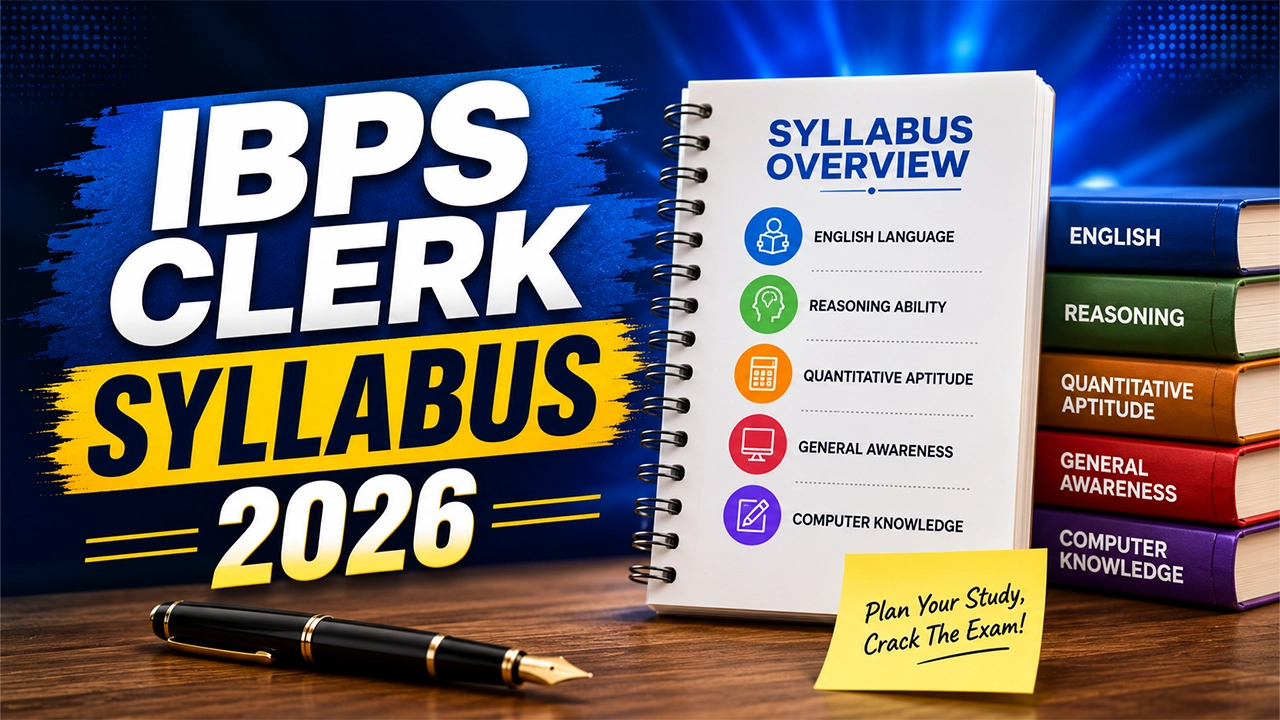
To facilitate the recruitment of administrative staff for participating public sector banks nationwide, the Institute of Banking Personnel Selection (IBPS) administers the IBPS Clerk examination annually. For candidates dedicated to clearing the exam, thoroughly understanding the IBPS Clerk Syllabus 2026 and its associated testing structure is the essential first step. While the Preliminary and Main examinations evaluate similar core competencies, they differ significantly regarding time limits, maximum marks, and the total number of questions.
IBPS Clerk 2026 Selection Process Overview
The hiring process for IBPS Clerks is divided into three distinct phases. Candidates should note that personal interviews are entirely excluded from this recruitment cycle.
- Stage 1 – Preliminary Exam: This is an objective, Computer Based Test (CBT) featuring 100 questions for 100 marks, with a strict 60-minute time limit. This phase serves purely as a screening test; scores achieved here do not contribute to the final merit list. Applicants must surpass both sectional and overall cut-offs to advance.
- Stage 2 – Main Exam: The Mains stage consists of 155 objective questions totalling 200 marks, allotted 120 minutes. The marks secured in this round exclusively determine a candidate’s placement on the final merit list.
- Stage 3 – Language Proficiency Test (LPT): Administered by the specific bank to which an applicant is assigned, this mandatory assessment evaluates the candidate’s reading, writing, and comprehension proficiency in the applied state’s official regional language. Although qualifying in nature, failing the LPT can result in immediate disqualification, even if the candidate successfully cleared the Prelims and Mains.
Both written stages implement a penalty system where 0.25 marks are deducted for every incorrect response. Unattempted questions carry no penalty.
IBPS Clerk Exam Pattern 2026
Preliminary Examination Pattern
The Prelims phase consists of three distinct sections, each enforced with a rigid 20-minute limit.
| Section | Questions | Marks | Duration |
| English Language | 30 | 30 | 20 minutes |
| Numerical Ability | 35 | 35 | 20 minutes |
| Reasoning Ability | 35 | 35 | 20 minutes |
| Total | 100 | 100 | 60 minutes |
Category-wise (UR/EWS/OBC/SC/ST) minimum qualifying marks are not detailed in current reference materials; applicants are advised to consult the official IBPS notification for precise cut-off data.
Mains Examination Pattern
The Main exam features four sections, each possessing individual time limits. With the exception of the English Language segment, the paper is presented bilingually (English and Hindi).
| Section | Questions | Marks | Duration |
| Reasoning Ability & Computer Aptitude | 40 | 60 | 35 minutes |
| English Language | 40 | 40 | 35 minutes |
| Quantitative Aptitude | 35 | 50 | 30 minutes |
| General/Financial Awareness | 40 | 50 | 20 minutes |
| Total | 155 | 200 | 120 minutes |
Comprehensive IBPS Clerk Syllabus 2026
Both the Preliminary and Main phases assess three mutual disciplines: Reasoning Ability, English Language, and Quantitative/Numerical Ability. The Mains exam subsequently introduces General/Financial Awareness and Computer Aptitude.
1. Reasoning Ability (Prelims & Mains)
This segment measures problem-solving agility and logical pattern recognition.
- Seating Arrangement & Puzzles
- Syllogism
- Coding-Decoding
- Blood Relations
- Direction Sense
- Inequalities (including coded inequalities in Mains)
- Alphanumeric Series, Order & Ranking
- Input-Output (including machine input-output in Mains)
- Data Sufficiency
- Statement & Conclusions, Statement & Assumptions, Statement & Arguments
- Series Test, Odd Figure Out, Analogy, Classification
- Assertion and Reasoning, Decision Making (Mains)
2. English Language (Prelims & Mains)
An identical syllabus for both stages focusing on linguistic comprehension.
- Vocabulary: Synonyms, Antonyms, Homonyms, Word Formation, Spelling
- Grammar: Spotting Errors, Sentence Improvement/Correction, Phrases and Idioms, Active/Passive Voice, Direct and Indirect Speech
- Reading & Comprehension: Reading Comprehension, Cloze Test, Para Jumbles, Fill in the Blanks, Passage Completion, Theme Detection, Deriving Conclusions
3. Quantitative/Numerical Ability (Prelims & Mains)
Assesses mathematical accuracy and raw calculation velocity.
- Simplification/Approximation
- Number Series
- Data Interpretation (Tables, Bar Graphs, Line Charts, Pie Charts)
- Quadratic Equations
- Data Sufficiency
- Ratio and Proportion, Percentages, Averages
- Profit, Loss and Discount
- Simple and Compound Interest
- Time, Speed and Distance; Time and Work
- Mensuration, Mixture and Allegation, Partnership
- Permutation, Combination and Probability
4. Computer Aptitude (Mains Only)
Merged with the Reasoning section during the Mains exam.
- Basics of Computer Hardware and Software
- Windows Operating System Basics
- Internet Terms, Services and Networking
- MS Office Basics (MS Word, MS Excel, MS PowerPoint)
- Database Basics
- History of Computers
- Basics of Hacking, Security Tools and Viruses
5. General/Financial Awareness (Mains Only)
Concentrates on global banking trends and current macroeconomic affairs.
- Current Affairs: National and international news of the last 6 months, Union Budget and Economic Survey highlights, Government Schemes and Policies
- Banking & Financial Awareness: Overview of the Indian financial system, history of Indian banking, recent RBI monetary and credit policies, banking terms and abbreviations
- Regulatory & International Bodies: RBI, SEBI, IRDAI, FSDC and international organisations such as IMF, World Bank, ADB, UN
- Static GK: Important Days, Books and Authors, Awards, Headquarters, Appointments
Note: As this curriculum is projected from past cycles, candidates should verify all topics against the official IBPS Clerk notification PDF upon its release on ibps.in.
Recommended Preparation Strategy
- Start with the syllabus, not random practice: Map out every topic under each subject before picking up question banks, so you know exactly what to cover.
- Build a sectional timetable: Since each Prelims section has its own 20-minute limit, practise solving sets within that time rather than untimed.
- Prioritise high-frequency topics: Puzzles and seating arrangement, data interpretation, and reading comprehension typically carry more questions than other topics within their sections, so give them proportionally more practice time.
- Attempt previous year question papers and mock tests regularly: This builds familiarity with the actual question style and helps track speed and accuracy improvement over time.
- Track and revise weak areas weekly: After every mock test, list the topics where you lost the most marks and dedicate the next few study sessions to just those.
- Don’t ignore Computer Aptitude and General Awareness for Mains: These sections are often under-prepared but can be scored quickly with static study material and daily current affairs revision.
IBPS Clerk Syllabus 2026 – Frequently Asked Questions
Q1. What does the IBPS Clerk syllabus 2026 include?
The Preliminary examination evaluates candidates across three primary subjects: Quantitative/Numerical Ability, English Language, and Reasoning Ability. For the Mains examination, the syllabus integrates these initial subjects while additionally introducing Computer Aptitude alongside General/Financial Awareness.
Q2. Can you explain the exam pattern for IBPS Clerk 2026?
The Preliminary stage is divided into three sections featuring 100 questions that carry a total of 100 marks, to be finished within a 60-minute duration. Conversely, the Mains stage expands into four sections consisting of 155 questions worth 200 marks. The Mains paper is allocated a total of 120 minutes, with each individual section possessing its own strict sectional time limit.
Q3. What is the total question count in the IBPS Clerk exam?
Based on the referenced examination pattern, candidates will face exactly 100 questions during the Prelims paper. Those who advance to the Mains phase will be required to answer 155 questions.
Q4. Does the IBPS Clerk exam apply negative marking?
Yes. The examination authority implements a strict penalty system. For every incorrect answer submitted in both the Prelims and Mains phases, a deduction of 0.25 marks is applied. However, candidates face no penalty for questions left unattempted.
Q5. Are the IBPS Clerk and IBPS PO syllabi identical?
The reference materials utilized to detail this information do not confirm this specific comparison, and such a conclusion should not be assumed. Aspirants preparing for both assessments are strongly advised to independently verify the official IBPS PO syllabus rather than presuming the topic coverage remains entirely identical.


1 thought on “IBPS Clerk Syllabus 2026: Complete Prelims & Mains Exam Pattern”