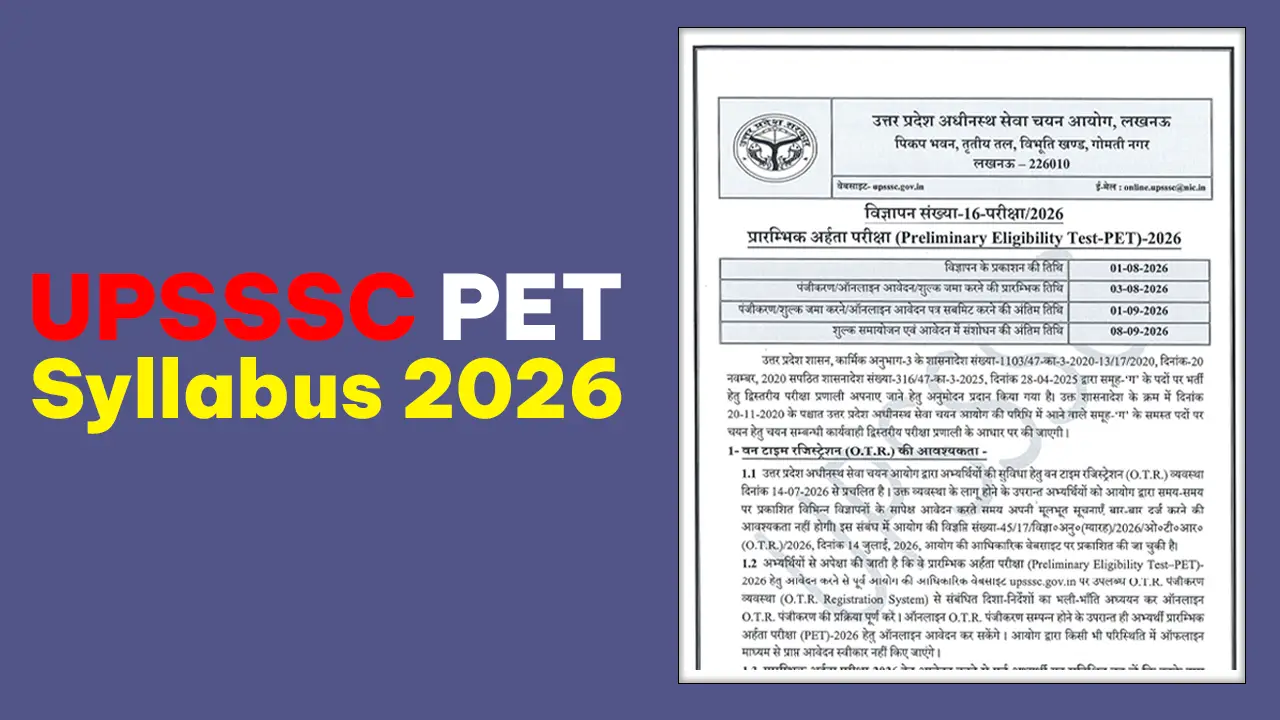
The Uttar Pradesh Subordinate Services Selection Commission (UPSSSC) has officially issued the syllabus and examination structure for the Preliminary Eligibility Test (PET) Exam 2026 across its web portal. Functioning as a mandatory qualifying test for recruitment to various Group B and Group C posts in the state of Uttar Pradesh, the assessment serves as the benchmark evaluation for regional government job seekers. Candidates planning to appear for this eligibility test must begin their preparation by gaining a comprehensive understanding of the updated curriculum, as a clear grasp of subject-specific topics enables focused and organized study.
The UPSSSC PET curriculum spans multiple disciplines, evaluating applicants on Indian History, Indian National Movement, Geography, Indian Economy, Constitution and Public Administration, General Science, Elementary Arithmetic, General Hindi, General English, Logic and Reasoning, Current Affairs, General Awareness, Analysis of Hindi Unread Passage, Graph Interpretation, and Table Interpretation.
UPSSSC PET Syllabus 2026 PDF
Administered strictly in an objective-type format, the UPSSSC PET question paper comprises multiple-choice questions covering the curriculum prescribed by the commission. Aspirants are advised to review the full curriculum to identify all topics requiring coverage during their study schedules.
The detailed syllabus spans history, geography, science, economy, polity, reasoning, mathematics, language, current affairs, and data interpretation. Candidates can access the official document through the link below:
| UPSSSC PET Syllabus 2026 | Download PDF |
|---|
UPSSSC PET 2026 Exam Pattern
The UPSSSC PET 2026 written examination comprises 100 objective-type questions carrying a cumulative score of 100 marks. Candidates are allocated a total duration of 2 hours to complete the paper. Every correct response is awarded 1 mark, while a negative marking deduction of 0.25 marks applies to incorrect answers.
| Subject | No of Questions | Marks |
| Indian History | 5 | 5 |
| Indian National Movement | 5 | 5 |
| Geography | 5 | 5 |
| Indian Economy | 5 | 5 |
| Indian Constitution & Public Administration | 5 | 5 |
| General Science | 5 | 5 |
| Elementary Arithmetic | 5 | 5 |
| General Hindi | 5 | 5 |
| General English | 5 | 5 |
| Logic & Reasoning | 5 | 5 |
| Current Affairs | 10 | 10 |
| General Awareness | 10 | 10 |
| Analysis of Hindi Unread Passage | 10 | 10 |
| Graph Interpretation | 10 | 10 |
| Table Interpretation | 10 | 10 |
| Total | 100 | 100 |
UPSSSC PET Syllabus 2026 Subject-Wise Topics
Reviewing the topic breakdown mapped by the commission enables aspirants to structure their study strategies efficiently. The detailed section-wise topics for the UP PET Exam 2026 include:
Indian History
- Indus Valley Civilization
- Vedic Culture
- Buddhism: Gautam Buddha (biography & teachings)
- Jainism: Mahavir (biography & teachings)
- Mauryan Dynasty: Emperor Ashoka
- Gupta Dynasty: Samudragupta, Chandragupta II
- Harshavardhan
- Rajput Period
- Sultanate Period
- Mughal Empire
- Marathas
- Rise of British Rule & the First War of Independence
- Socio-economic impact of British Rule
Indian National Movement
- Early years of the freedom movement
- Swadeshi & Civil Disobedience Movements: role of Mahatma Gandhi and other leaders
- Revolutionary movements and rise of extremist nationalism
- Legislative reforms and the Government of India Act, 1935
- Quit India Movement, Azad Hind Fauj, and Netaji Subhas Chandra Bose
Geography
- Physical geography of India and the world
- Rivers and river valleys
- Groundwater resources
- Mountains, hills and glaciers
- Deserts and arid regions
- Forests
- Mineral resources (especially in India)
- Political geography of India and the world
- Climate and weather
- Time zones
- Demographic change and migration
Indian Economy
- Indian economy (1947 to 1991)
- Planning Commission and Five-Year Plans
- Development of the mixed economy: private and public sectors
- Green Revolution
- White Revolution / Operation Flood
- Nationalization and reform of banks
- Economic reforms of 1991 and the post-reform economy
- Economic reforms after 2014
- Agricultural reforms
- Infrastructure reforms
- Labour reforms
- Economic reforms
- GST
Indian Constitution & Public Administration
- Indian Constitution
- Key features of the Indian Constitution
- Directive Principles of State Policy
- Fundamental Rights and Duties
- Parliamentary system
- Federal system, Union & Union Territories, Centre-State relations
- Judicial structure – Supreme Court, High Courts
- District administration
- Local bodies and Panchayati Raj institutions
General Science
- Elementary Physics
- Elementary Chemistry
- Elementary Biology
Elementary Arithmetic
- Whole numbers, fractions and decimals
- Percentage
- Simple arithmetic equations
- Squares and square roots
- Exponents and powers
- Average
सामान्य हिन्दी (General Hindi)
- संधि
- विलोम शब्द
- पर्यायवाची शब्द
- वाक्यांशों के लिए एक शब्द
- लिंग
- समश्रुत भिन्नार्थक शब्द
- मुहावरे- लोकोक्तियाँ
- सामान्य अशुद्धियां
- लेखक और रचनाएँ (गद्य एवं पद्य)
General English
- English Grammar
- Unseen passage-based questions
Logic & Reasoning
- Large and small
- Order and ranking
- Relationships
- Odd one out
- Calendar and clock
- Cause and effect
- Deductive reasoning / statement analysis and conclusion
- Coding-decoding (numbers and letters)
Current Affairs
- Indian and global
General Awareness
- India’s neighboring countries
- Countries, capitals and currencies
- Indian states and union territories
- Indian Parliament, Rajya Sabha, Lok Sabha and Vidhan Sabha, Vidhan Parishad
- National and international days
- World organizations and their headquarters
- Indian tourist destinations
- Indian art and culture
- Sports (India and world)
- Indian research organizations
- Famous books and authors
- Awards and winners
- Climate change and environment
Comprehension and Data Interpretation Sections
- Unseen Hindi Passage Comprehension & Analysis (2 passages, 5 questions each)
- Graph Interpretation & Analysis (2 graphs, 5 questions each)
- Table Interpretation & Analysis 10 marks (2 tables, 5 questions each)
Best Books for UPSSSC PET Exam 2026
Candidates preparing for the upcoming UPSSSC Preliminary Eligibility Test (PET) can refer to these commonly known titles to assist their exam preparation:
| Subject/Topics | Book Name | Author/Publisher |
| General Knowledge | Arihant General Knowledge | Manohar Pandey |
| UP General Knowledge | Uttar Pradesh General Knowledge | Arihant |
| History/Geography/Polity basics | NCERT Class 6–10 | NCERT |
| Static & Current GK combo | Ghatna Chakra (PYQ-based) | Ghatna Chakra |
| General English | General English | Upkar Publication |
| Hindi | Hindi grammar + unseen passage practice | Lucent/Arihant |
| Full syllabus (all-in-one) | UPSSSC PET 2026 Complete Guide (2000+ Qs, PYQs 2021–25, 3 practice sets) | Arihant |
Preparation Tips for UP PET Exam 2026
Candidates aiming to secure strong scores in the UP PET Exam 2026 can follow these established preparation measures:
- Begin by understanding the latest syllabus and dividing topics as per the difficulty and importance.
- Prepare a daily study schedule and allocate proper time for each subject.
- Focus on basic concepts before moving to trickier topics.
- Practise arithmetic, reasoning and data interpretation questions regularly.
- Read newspapers and current affairs regularly.
- Revise important facts, formulas, dates and concepts on daily basis.
- Solve previous year question papers and mock tests.
Candidates must begin their preparation for the UPSSSC PET Exam 2026 using the official syllabus and exam pattern given in this article. Download the syllabus and start with a study plan that suits you as per your strength and weakness.
UPSSSC PET Syllabus 2026 – FAQs
1. What is the UPSSSC PET Exam 2026?
The UPSSSC Preliminary Eligibility Test (PET) 2026 is a qualifying examination conducted by the Uttar Pradesh Subordinate Services Selection Commission (UPSSSC) for recruitment to various Group B and Group C posts in Uttar Pradesh.
2. What subjects are included in the UPSSSC PET Syllabus 2026?
The syllabus covers Indian History, Indian National Movement, Geography, Indian Economy, Indian Constitution and Public Administration, General Science, Elementary Arithmetic, General Hindi, General English, Logic and Reasoning, Current Affairs, General Awareness, Hindi passage comprehension, Graph Interpretation, and Table Interpretation.
3. What is the UPSSSC PET 2026 exam pattern?
The examination consists of 100 objective-type multiple-choice questions carrying a total of 100 marks. Candidates get 2 hours to complete the examination.
4. Is there negative marking in the UPSSSC PET 2026 exam?
Yes. 0.25 marks are deducted for each incorrect answer in the UPSSSC PET 2026 written examination.
5. How many questions are asked from each subject?
Most of the individual subjects carry 5 questions and 5 marks, while Current Affairs, General Awareness, Hindi passage comprehension, Graph Interpretation, and Table Interpretation carry 10 questions or marks each, as specified in the exam pattern.
6. What topics are covered under Indian History in the UPSSSC PET Syllabus?
The Indian History section includes topics such as the Indus Valley Civilization, Vedic Culture, Buddhism, Jainism, Mauryan and Gupta dynasties, Harshavardhan, Rajput and Sultanate periods, Mughal Empire, Marathas, the rise of British rule, the First War of Independence, and the socio-economic impact of British rule.
7. Does the UPSSSC PET Syllabus include Mathematics and Reasoning?
Yes. Elementary Arithmetic includes topics such as percentages, fractions, decimals, averages, squares and square roots, exponents and powers, and basic arithmetic equations. Logic and Reasoning includes topics such as ranking, relationships, coding-decoding, calendars and clocks, cause and effect, and statement-based reasoning.
8. Are Hindi and English included in the UPSSSC PET syllabus?
Yes. General Hindi includes grammar and vocabulary-related topics such as Sandhi, antonyms, synonyms, idioms and proverbs, sentence errors, and authors and their works. General English includes English grammar and unseen passage-based questions.
9. Does the UPSSSC PET exam include Current Affairs and General Awareness?
Yes. Current Affairs covers Indian and global events. General Awareness includes areas such as neighboring countries, states and Union Territories, the Indian Parliament, important national and international days, world organizations, art and culture, sports, research organizations, books and authors, awards, climate change, and the environment.
10. Does the UPSSSC PET exam include data interpretation?
Yes. The syllabus includes Graph Interpretation and Table Interpretation. Candidates also have to prepare for Hindi unseen passage comprehension and analysis.
11. Where can I download the UPSSSC PET Syllabus 2026 PDF?
Candidates can download the detailed UPSSSC PET Syllabus 2026 PDF through the official UPSSSC portal. The syllabus link provided in the article can also be used to access the document.
12. Which books can help with UPSSSC PET 2026 preparation?
The article recommends resources such as Arihant General Knowledge, Uttar Pradesh General Knowledge, NCERT textbooks for Classes 6–10, Ghatna Chakra previous-year-question resources, General English and Hindi preparation books, and an all-in-one UPSSSC PET preparation guide.
13. How should I prepare for the UPSSSC PET Exam 2026?
Candidates should first understand the syllabus and exam pattern, create a subject-wise study schedule, strengthen basic concepts, practise arithmetic, reasoning and data interpretation regularly, follow current affairs, revise important facts and formulas, and solve previous-year papers and mock tests.