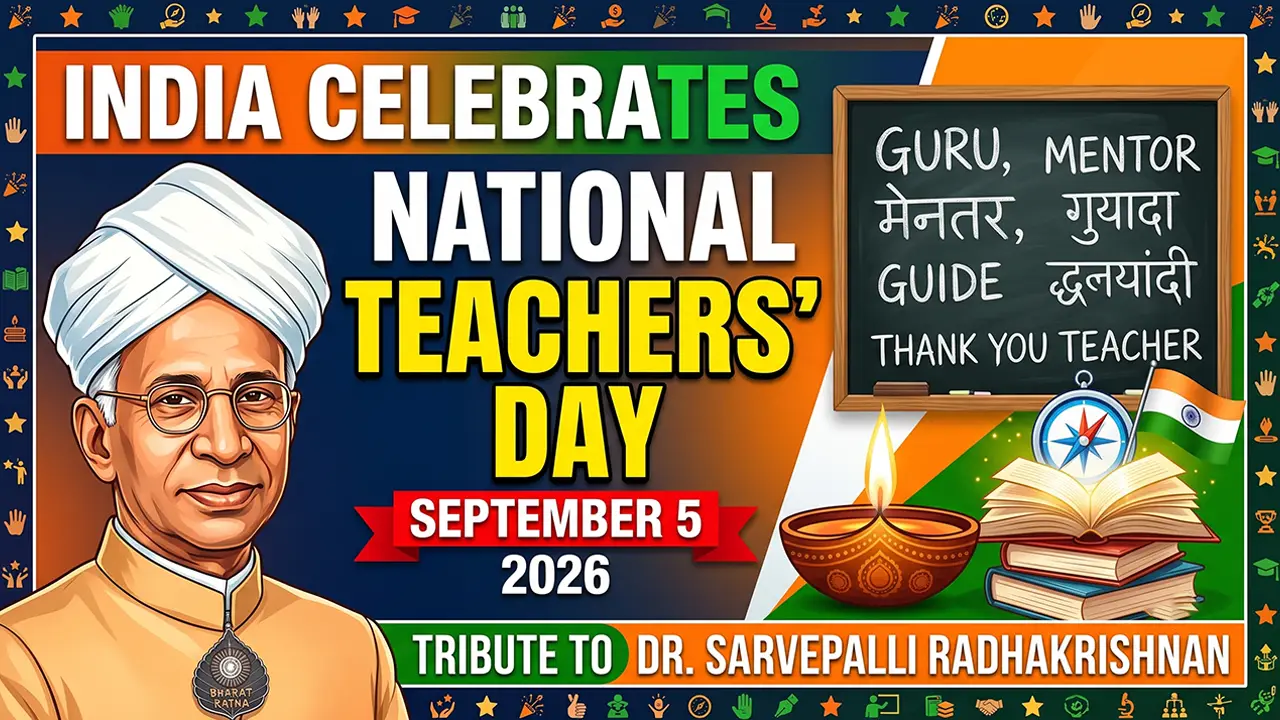
Every September 5, India observes Teachers’ Day to honour the contributions of educators across the nation. Educational institutions commemorate the occasion with programmes entirely dedicated to their teaching staff. Often, students organise games, performances, and various cultural events. A popular tradition involves a respectful role reversal where teachers take a break from their regular classroom duties while senior students assume teaching roles for younger pupils, sometimes even respectfully mimicking their instructors.
The History Behind September 5
The specific date is intrinsically connected to Dr. Sarvepalli Radhakrishnan, India’s second President, who was a distinguished scholar and philosopher. Born on September 5, 1888, his birthday became the foundation for this national observance. The tradition initiated in 1962 after he assumed the presidency; when admirers and students expressed a desire to celebrate his birthday, Radhakrishnan proposed that the day be dedicated to honouring the teaching profession instead.
Who Was Dr. Sarvepalli Radhakrishnan?
Beyond his role as President, Radhakrishnan spent a significant portion of his career in the education sector as a philosopher and teacher. He taught philosophy at multiple institutions and held the position of Vice-Chancellor at both Andhra University and Banaras Hindu University. Eventually, he served as India’s first Vice-President before becoming its second President.
His philosophical views on learning continue to resonate with the essence of Teachers’ Day. During a previous Teachers’ Day speech, former President Pranab Mukherjee quoted Radhakrishnan directly:
“The aim of education is not the acquisition of information… but the development of that bent of mind, that attitude of reason, that spirit of democracy, which will make us responsible citizens.”
For Radhakrishnan, education extended far beyond technical skills, examinations, or textbooks. He believed it was fundamentally about fostering responsible citizenship, reason, and independent thinking. Furthermore, September 5, 2026 also marks the 51st death anniversary of Radhakrishnan, who died on April 17, 1975.
Influence on India’s Higher Education
In 1948, shortly after Independence, the government established the University Education Commission with Radhakrishnan serving as its chairman. This commission evaluated the condition of university education and proposed modifications to meet India’s future requirements. The resulting 1948-49 report laid an essential foundation for higher education development in independent India.
These recommendations shaped academic organisation, research, teaching standards, and university education overall. Government documents identify this report, alongside the subsequent Kothari Commission report, as a landmark foundation for later education policy. Additionally, the concept of institutions being recognised as “deemed to be universities” originated from recommendations of the Radhakrishnan Commission.
Events Planned for Teachers’ Day 2026
The 2026 observance will feature the presentation of the National Teachers’ Awards. On September 5, President Droupadi Murmu will confer these awards upon 48 school teachers in New Delhi. The recipients emerged from a rigorous three-stage process at the district, state, and national levels. These chosen educators represent 27 states, seven Union Territories, and six central government organisations.
Instituted in 1958, the National Teachers’ Awards were created to recognise teachers who have made notable contributions to school education and enriched the lives of their students.
Distinguishing From World Teachers’ Day
India’s national observance should not be confused with World Teachers’ Day, which is observed globally on October 5. According to UNESCO, the day has been celebrated since 1994 and marks the anniversary of the adoption of the 1966 ILO, UNESCO recommendation concerning the Status of Teachers. This recommendation established international standards concerning teachers’ rights, responsibilities, preparation, employment, and working conditions.
In 2026, World Teachers’ Day will mark the 60th anniversary of that recommendation, with a focus on protecting and advancing the status of teachers in a changing world.