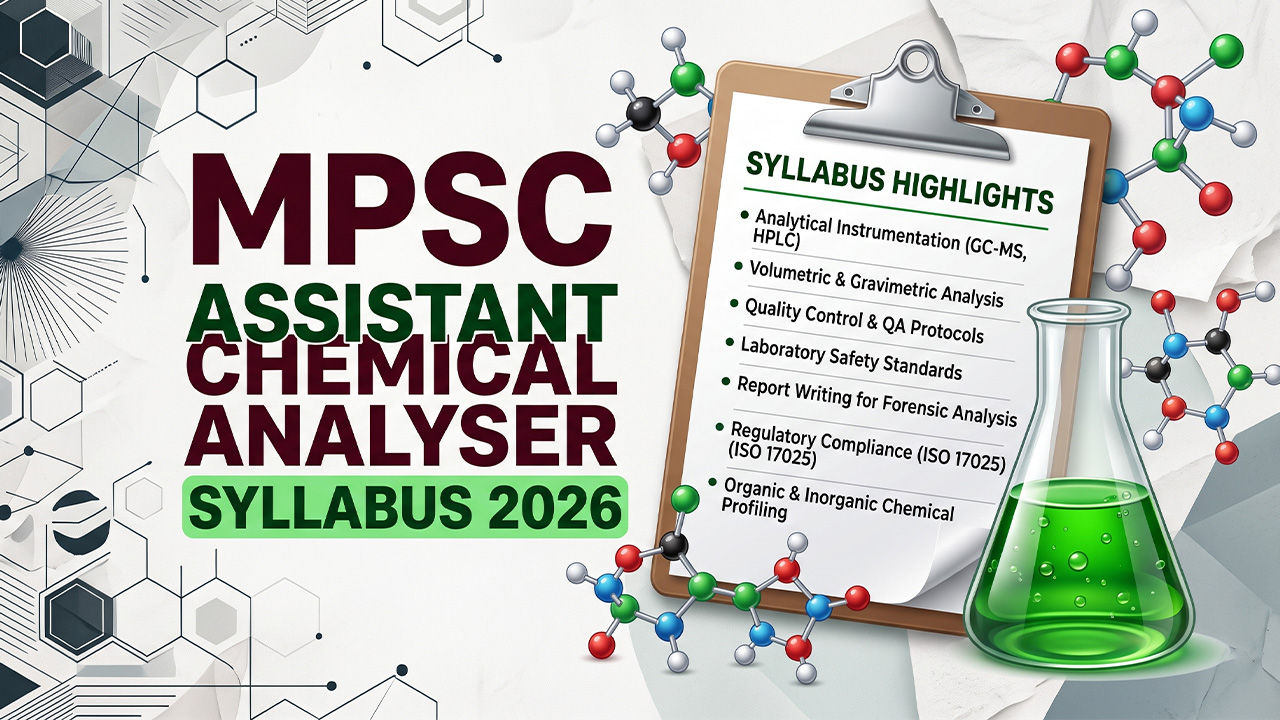
MPSC Assistant Chemical Analyser Syllabus 2026 Released for DFSL Group-B Post
The Maharashtra Public Service Commission (MPSC) has published the comprehensive syllabus for the post of Assistant Chemical Analyser within the Directorate of Forensic Science Laboratories (DFSL), falling under the General State Services, Group-B cadre of the Home Department, Government of Maharashtra. Candidates preparing for this competitive assessment can access the formal, subject-wise curriculum derived from the commission’s authorized documentation. The test framework encompasses extensive concepts spanning Analytical Chemistry, Inorganic Chemistry Techniques, Organic Chemistry Techniques, and Biochemistry Techniques.
MPSC Assistant Chemical Analyser Exam 2026: Key Highlights
The examination serves as a selection mechanism for Group-B technical positions within the state’s forensic science department.
| Particulars | Details |
| Conducting Body | Maharashtra Public Service Commission (MPSC) |
| Post Name | Assistant Chemical Analyser |
| Department | Directorate of Forensic Science Laboratories (DFSL), Home Department, Government of Maharashtra |
| Service Category | General State Services, Group-B |
| Number of Subjects/Units in Syllabus | 4 (Analytical Chemistry, Inorganic Chemistry Techniques, Organic Chemistry Techniques, Biochemistry Techniques) |
| Total Questions | 100 Questions |
| Total Marks | 200 marks |
| Exam Duration | One Hour |
| Official Website | mpsc.gov.in |
Comprehensive Unit-Wise Syllabus Breakdown
The prescribed syllabus is arranged into four core units evaluating analytical chemistry principles alongside their application to inorganic, organic, and biochemical specimens.
Unit 1: Analytical Chemistry
- (A) Basic Aspects:
- Sampling procedures for solid, liquid, and gas samples
- Molecular and equivalent weight
- Calculations of molarity, molality, and normality
- Solution preparation based on w/w, w/v, and v/v metrics
- Mole concept, concentration parameters, ppm, ppb, and ppt
- Calibration and validation processes, including calibration curves, regression analysis, external standards, internal standards, and standard addition methods
- (B) Statistical Treatment of Results:
- Concepts of accuracy, precision, sensitivity, and detection limits
- Error classification, mean, median, standard deviation, and relative standard deviation
- Gaussian curves, t-test, F-test, and confidence intervals
- Method selection benchmarks: accuracy, precision, sensitivity, selectivity, specificity, and detection limits
- (C) Titrimetry:
- Titration categories: acid-base, complexometric, redox, and precipitation titrations
- Standardisation materials: primary standards and secondary standards
- Applications and mechanics of potentiometric and conductometric titrations
- (D) Gravimetric and Thermogravimetric Analysis:
- Precipitation mechanisms and diverse precipitants utilized in gravimetric analysis
- pH parameters necessary for precipitation
- Quantitative analysis methodology
- Thermogravimetric analysis procedures
- Mass spectrometry applications for qualitative and quantitative determinations, including associated problem-solving
- (E) Separation Techniques:
- Extraction protocols
- Distillation methodologies: vacuum distillation, steam distillation, and fractional distillation
- Procedures for the purification and identification of chemical substances
Unit 2: Analytical Techniques in Inorganic Chemistry for Different Inorganic Samples
- (A) Spectroscopy and Chromatography for Inorganic Sample Analysis:
- Atomic absorption, atomic emission, inductively coupled plasma-atomic emission spectrometry (ICP-AES), and inductively coupled plasma-mass spectrometry (ICP-MS)
- UV-Visible spectroscopy for qualitative and quantitative assessments, Job’s Method, and relevant applications
- Ion exchange chromatography for evaluating inorganic cations and anions
- (B) Microscopy for Inorganic Sample Analysis:
- Trace and heavy metal, glass, soil, and liquid examination utilizing Scanning Electron Microscopy (SEM)
- Energy Dispersive Spectroscopy (EDS)
- (C) Electroanalytical Techniques:
- Coulometric methods and classifications
- Amperometry, voltammetry, cyclic voltammetry, and stripping voltammetry
- Polarography techniques
Unit 3: Analytical Techniques in Organic Chemistry
- (A) Spectroscopy:
- Principles and applications of UV-Visible, Infrared (FTIR), Raman, Nuclear Magnetic Resonance (NMR), and Mass spectrometry
- Spectral data interpretation and molecular structure elucidation
- (B) Separation Techniques:
- Theoretical fundamentals and practical analytical applications of TLC, HPTLC, GC, GC-MS, LC-MS, HRMS, column chromatography, and paper chromatography
- High-Performance Liquid Chromatography (HPLC) parameters: ion exchange, adsorption, normal phase, reverse phase chromatography, and solid phase extraction
- (C) Organic Analysis:
- Examination of pharmaceutical compounds, narcotic drugs, and psychotropic substances
- Alcohol estimation procedures
- Analysis of petroleum fractions, paints, dyes, rubber, plastics, and synthetic or natural fibres
- Detection of organic poisons, encompassing insecticides, pesticides, herbicides, and related agents
Unit 4: Analytical Techniques in Biochemistry
- (A) Biomolecules:
- Structural properties, biological roles, and analytical estimation of carbohydrates, lipids, proteins, and nucleic acids
- Functions and composition of biological buffers
- (B) Molecular Biology:
- DNA isolation and DNA quantification protocols
- Polymerase Chain Reaction (PCR), Reverse Transcription PCR (RT-PCR), and Restriction Fragment Length Polymorphism (RFLP)
- Enzyme-Linked Immunosorbent Assay (ELISA) and Radioimmunoassay (RIA)
- Antigen-antibody interactions
- (C) Separation Techniques:
- SDS-PAGE, one-dimensional (PAGE), and two-dimensional electrophoresis
- Isoelectric focusing
- Gel filtration chromatography and affinity chromatography
- High voltage electrophoresis, agarose gel electrophoresis, and capillary electrophoresis
- (D) Isotope Tracer Technique:
- Foundational concepts and operational principles
- Practical advantages, operating constraints, and biochemical applications
- (E) Enzymes:
- Enzyme classification schemes and isoenzymes
- DNA polymerase properties
- Fundamentals of enzyme kinetics
- (F) Examination of Blood, Body Fluids, and Hair (Human and Animal):
- Blood group classification systems
- Forensic examination of semen, saliva, urine, hair, and sweat
- Handling and preservation of biological stains
Preparation Strategy for MPSC Assistant Chemical Analyser Exam 2026
- Prioritize Foundational Sections: Establish a structured study timetable addressing all four units, allocating dedicated time to Analytical Chemistry and Organic Chemistry techniques as they underpin the remaining curriculum.
- Master Instrumental Methodologies: Focus on the underlying principles, nomenclature, and functional applications of major instruments (such as ICP-MS, GC-MS, HPLC, and SEM-EDS), which are routinely emphasized in analytical examinations.
- Practice Statistical Computations: Dedicate separate revision sessions to statistical treatments of analytical data, including standard deviation, confidence intervals, t-tests, and F-tests.
- Synthesize Biochemical Separation Notes: Prepare concise study notes covering electrophoresis and biochemical separation methods to master topics overlapping with forensic biology.
- Solve Past Examination Papers: Review question papers from comparable analytical chemistry and forensic science recruitment tests to gauge question depth and assessment format.
- Monitor Official Portals: Track the official MPSC website for subsequent notices regarding the detailed exam pattern, mark allocations, and formal examination scheduling.
Important Links
| Link | URL |
| Syllabus PDF Download | Click Here |
| Official Website (MPSC) | mpsc.gov.in |
| DFSL Maharashtra Official Website | dfsl.maharashtra.gov.in |
MPSC Assistant Chemical Analyser Syllabus 2026 FAQs
1. What is the MPSC Assistant Chemical Analyser Syllabus 2026?
The MPSC Assistant Chemical Analyser Syllabus 2026 is the subject-wise curriculum prescribed for the Assistant Chemical Analyser post under the Directorate of Forensic Science Laboratories (DFSL), Home Department, Government of Maharashtra. The syllabus covers four major areas: Analytical Chemistry, Inorganic Chemistry Techniques, Organic Chemistry Techniques, and Biochemistry Techniques.
2. How many subjects are included in the MPSC Assistant Chemical Analyser Syllabus 2026?
The syllabus consists of four major units: Analytical Chemistry, Analytical Techniques in Inorganic Chemistry, Analytical Techniques in Organic Chemistry, and Analytical Techniques in Biochemistry.
3. What are the main topics in Analytical Chemistry?
The Analytical Chemistry unit includes sampling, solution preparation, concentration calculations, calibration and validation, statistical treatment of results, titrimetry, gravimetric analysis, thermogravimetric analysis, mass spectrometry, extraction, distillation, and chemical purification techniques.
4. What topics are covered under Inorganic Chemistry Techniques?
The Inorganic Chemistry unit covers techniques such as atomic absorption spectroscopy, atomic emission spectroscopy, ICP-AES, ICP-MS, UV-Visible spectroscopy, ion exchange chromatography, SEM, EDS, coulometry, amperometry, voltammetry, cyclic voltammetry, stripping voltammetry, and polarography.
5. What topics are included in Organic Chemistry Techniques?
The Organic Chemistry unit includes UV-Visible, FTIR, Raman, NMR, and mass spectrometry. It also covers TLC, HPTLC, GC, GC-MS, LC-MS, HRMS, HPLC, column chromatography, paper chromatography, and the analysis of pharmaceuticals, narcotic drugs, psychotropic substances, alcohol, petroleum products, paints, dyes, rubber, plastics, fibres, and organic poisons.
6. What topics are covered in Biochemistry Techniques?
The Biochemistry unit includes biomolecules, biological buffers, DNA isolation and quantification, PCR, RT-PCR, RFLP, ELISA, RIA, antigen-antibody interactions, electrophoresis, isoelectric focusing, gel filtration, affinity chromatography, isotope tracer techniques, enzymes, enzyme kinetics, and forensic examination of blood, body fluids, and hair.
7. What is the exam pattern for the MPSC Assistant Chemical Analyser Exam 2026?
According to the article, the examination consists of 100 questions carrying 200 marks, with a duration of one hour.
8. Which topics should candidates prioritize while preparing for the exam?
Candidates should first build a strong foundation in Analytical Chemistry and Organic Chemistry techniques. They should also focus on instrumental methods such as ICP-MS, GC-MS, HPLC, and SEM-EDS, along with statistical calculations and biochemical separation techniques.
9. Are statistical topics included in the MPSC Assistant Chemical Analyser Syllabus?
Yes. The syllabus includes statistical treatment of analytical results, including accuracy, precision, sensitivity, detection limits, errors, mean, median, standard deviation, relative standard deviation, Gaussian curves, t-test, F-test, and confidence intervals.
10. Does the syllabus include forensic examination of biological samples?
Yes. The Biochemistry unit includes the examination of blood, body fluids, and hair of human and animal origin. It covers blood groups, semen, saliva, urine, hair, sweat, and the handling and preservation of biological stains.
11. Where can candidates check the official MPSC Assistant Chemical Analyser Syllabus?
Candidates should refer to the official Maharashtra Public Service Commission (MPSC) website for the authorized syllabus and subsequent examination-related notices. The article identifies mpsc.gov.in as the official MPSC website.
12. Is the MPSC Assistant Chemical Analyser exam date mentioned in the syllabus article?
The article does not provide a specific examination date. Candidates are advised to monitor the official MPSC portal for further announcements regarding the examination schedule and other updates.