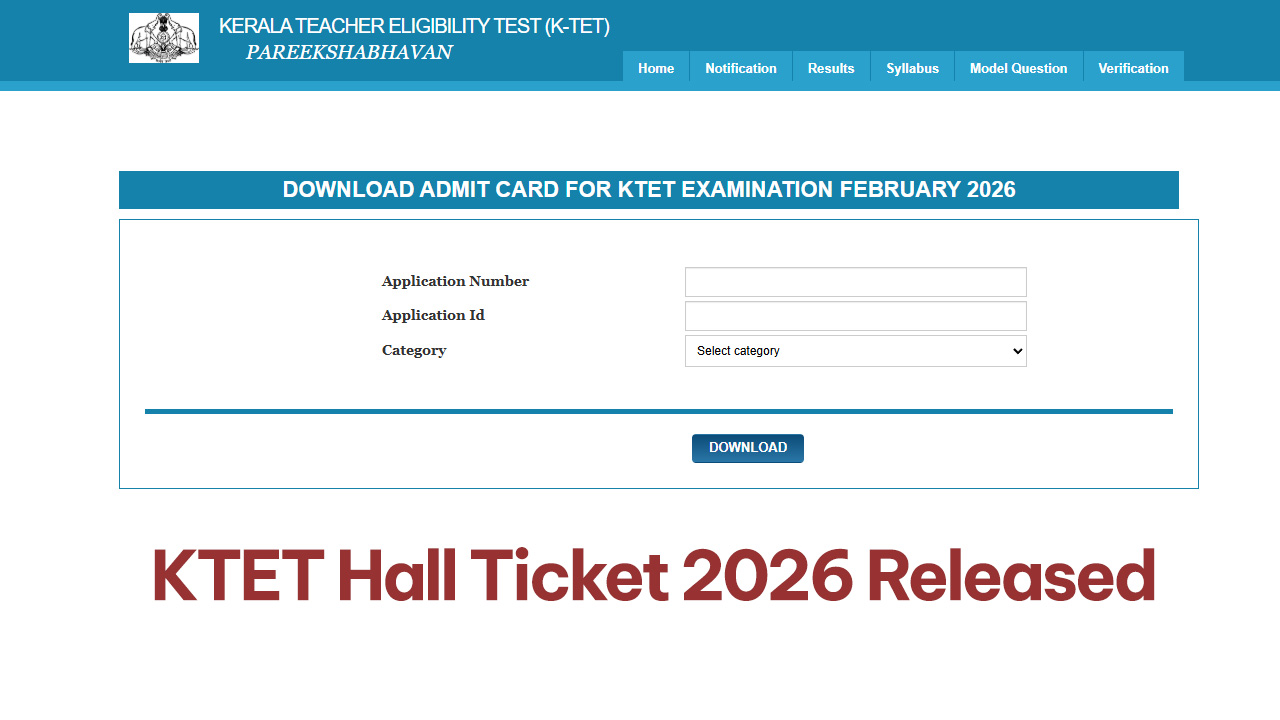
KTET Hall Ticket 2026 Out: Download at ktet.kerala.gov.in
The Kerala Pareeksha Bhavan (KPB) has officially issued the KTET Hall Ticket 2026 for the upcoming Kerala Teacher Eligibility Test (K-TET) February 2026 session. Candidates who successfully registered for the state-level examination can now access their admit cards and the detailed exam schedule pdf through the official portal at www.ktet.kerala.gov.in.
The written exam is scheduled to take place across the state on August 08 and 09, 2026. Securing the Kerala TET Admit Card 2026 is mandatory for applicants looking to demonstrate their aptitude and subject knowledge, which is a prerequisite for pursuing various teaching jobs in government and government-aided schools across Kerala.
How to Access the KTET Hall Ticket 2026 Download Link
The KPB has activated the direct download link on its web platform. Examinees participating in the K-TET February 2026 session must visit the official website to retrieve their hall tickets. This credential will contain vital details regarding the test center, timings, and applicant information.
Kerala TET Exam Date 2026 and Category Classifications
The Kerala Teacher Eligibility Test (K-TET) is systematically divided into four distinct categories, accommodating the different classes of teachers required across various school levels. The authority has designated these as Category I, II, III, and IV.
The classifications are structured as follows:
- Category I- Lower Primary (Classes 1 to 5): Designed for the primary school level.
- Category II- Upper Primary (Classes 6 to 8): Specifically for the upper primary level.
- Category III – High School (Classes 9 and 10): Intended for the high school level.
- Category IV – Specialist Teachers: Allocated for language subject teachers (Hindi, Arabic, Urdu), Physical Education teachers, and other specialised teaching roles.
KTET Exam Pattern 2026 Explained
Regardless of the category, each classification requires candidates to complete a single paper. The examination will feature 150 objective Multiple-Choice Questions (MCQs), carrying a total of 150 marks.
The assessment covers several key areas, including child development/pedagogy, languages, and core subjects. The questions are strictly grounded in the SCERT syllabi. However, the difficulty will vary, ranging from secondary to degree levels, depending strictly on the specific category an applicant has chosen.
Candidates should note that the evaluation process is fully computerized, utilizing Optical Mark Reader (OMR) sheets. Furthermore, there is no negative marking applied in the exam, allowing test-takers to attempt all questions without penalty.